A town of timber, stone and powerful women
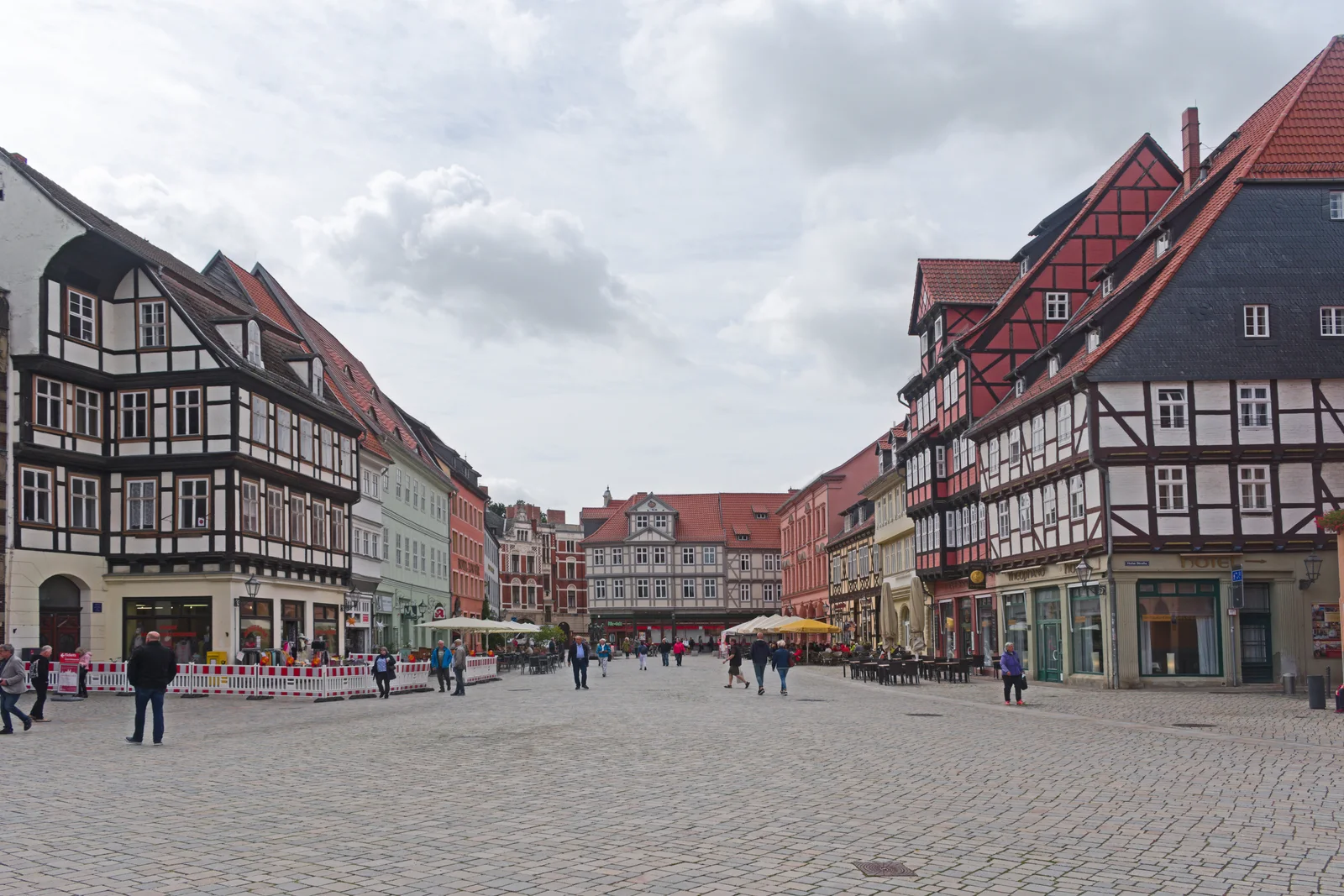
At the northern edge of the Harz in Saxony-Anhalt, Quedlinburg rewards a walk with frequent pauses: a patterned timber facade, a sloping lane, then the sandstone hill carrying St Servatius. UNESCO's heritage account connects that streetscape to the town's role as an Ottonian royal center and a trading settlement. The photographs here are archival views, not a report of today's weather or building arrangements.
History: beyond the bird-catching story
Quedlinburg's first written mention dates to 922, in a document of King Henry I. His burial here in 936 gave the royal hill an enduring role as a place of remembrance. Queen Mathilde established a women's religious foundation that year, supported by Otto I; its abbesses became consequential figures in the town's political and economic life. The foundation survived until its dissolution in 1802. These are documented milestones in the municipality's chronology and the Stiftsberg's historical account.
The familiar Finkenherd story places Henry at his bird nets when news of his election as king arrived in 919. The town itself presents this as a tradition, not proof that the scene occurred there. It is a useful story to recognize while walking, but should not replace the documentary history.
Below the hill, market, minting and toll rights granted in 994 helped the settlement develop. Quedlinburg later belonged to the Hanseatic League, from 1426 to 1477. Its surviving timber buildings are not all medieval: their differing forms reflect successive centuries of urban life. In 1994 the collegiate church, castle and old town entered the World Heritage List, recognizing the relationship between royal history, Romanesque architecture and the historic street plan. UNESCO explains that significance.
Five reasons to visit
- Follow the abbesses onto the Stiftsberg. The redesigned Schlossmuseum and collegiate-church circuit opened on 3 October 2026, according to the site's own visitor page. Its museum tells the history through women who exercised both religious responsibility and worldly power; St Servatius adds Romanesque architecture and the church treasury.
- Read the streets as an architectural collection. Walk from the Markt into the old town's lanes and compare the timber patterns rather than treating every house as the same age. The official museum guide describes the Fachwerkmuseum im Ständerbau, which explains timber construction across six centuries.
- Meet modern art at Museum Lyonel Feininger. At Schlossberg 11, the collection associated with Quedlinburg resident Hermann Klumpp gives the historic center a different cultural register. The municipality's museum listing documents the Feininger prints and the museum's origins in 1986. Its listed closing day is Tuesday: useful when planning today's visit.
- Explore the Münzenberg's layered history. Across from the royal hill, St Marien's surviving church fabric was incorporated into later houses. The official tourism listing for its museum explains the remains of the Ottonian basilica and their recovery for visitors. Pair the museum with an outdoor walk through the hillside neighborhood; check its current opening arrangements directly because published schedules differ.
- Make a food stop specific to this town. Käsekuchenbäckerei Vincent makes quark cheesecake at the foot of the Schlossberg. Brauhaus Lüdde connects regional dishes and house-brewed beer with a historic brewing installation in its covered courtyard. These are researched choices, with direct information below.
At the table
Vincent describes its cheesecake as made with quark, cream and shortcrust pastry, with sweet and savory variations. Its own page also identifies cheeses from nearby Westerhausen among its savory ingredients. That is a specific local bakery and producer connection, rather than a claim that every variation is an ancient Quedlinburg tradition. At Lüdde, the connection is brewing on the premises and regional cooking. Consult the businesses for that day's selection; no particular flavor, dish or table is promised. Bakery details · Brewery restaurant.
When to go and how to arrive
For a visit built around walking and museums, late spring through early autumn is a practical editorial choice; October combines outdoor streets with indoor cultural stops and the newly opened Stiftsberg circuit. Bring layers and allow for wet cobbles. This is not a forecast or a promise of autumn color. The Stiftsberg currently lists March–October visiting hours separately from its shorter winter hours; use its visitor page before traveling.
Gateway: Magdeburg Hauptbahnhof, then regional rail to Quedlinburg via Halberstadt. The station's posted timetable shows the RE 11 corridor linking Quedlinburg, Halberstadt and Magdeburg. Check date-specific trains and disruptions through the official station page. The town's arrival guide supplies local maps and parking guidance, but its operator names should not substitute for current rail information. No journey time or step-free access is assumed here.
Local Resources
Resources checked: 2026-10-13. These are researched listings, not firsthand recommendations. Websites and the details below were checked; room availability, daily menus and individual departures were not. Confirm changing arrangements with each provider.
Start Here
- Quedlinburg-Information — The town tourism team provides planning information and guided-tour contacts. Location: Markt 4, in the town center. Visitor detail: its official site lists telephone and email contacts for questions about a stay.
See & Do
- Welterbe Stiftsberg — Schlossmuseum, St Servatius and the treasury connect royal history with the abbesses' authority. Location: Stiftsberg above the old town. Visitor detail: the full museum circuit opened on 3 October 2026; the site currently lists Tuesday–Sunday/public-holiday opening and an earlier winter closing time.
- Museum Lyonel Feininger — official municipal listing — Feininger's graphic art adds a modern-art stop rooted in Hermann Klumpp's Quedlinburg collection. Location: Schlossberg 11. Visitor detail: the municipality lists Tuesday closure. This is an official-directory alternative because the museum's own homepage could not be read during this check.
- Museum Klosterkirche St Marien — official tourism listing — Preserved church remains reveal the earlier monastery beneath later domestic buildings. Location: Münzenberg 16, in the hillside neighborhood. Visitor detail: the listing supplies the museum's direct contact details; confirm the visiting day because official pages disagree on its summer closing days. This is an official-directory alternative to the museum's minimally readable homepage.
Eat & Drink
- Käsekuchenbäckerei Vincent — A town bakery specializing in quark cheesecake, with a documented link to nearby cheese producers. Location: Schlossberg 13, beside the Klopstock museum. Visitor detail: its website says it currently cannot accept table reservations.
- Brauhaus Lüdde — House-brewed beer and regional dishes in a former brewery courtyard, with the brewing installation at its center. Location: Blasiistraße 14, old town. Visitor detail: the direct site provides restaurant contact information and links to its current menus; specific dishes and prices are not asserted here.
Stay Local
- Hotel Theophano — The hotel's own site identifies it as family-run and places it directly on Quedlinburg's market square. Location: Markt 13/14, town center. Visitor detail: direct room information and inquiry links are available; its restaurant has seasonal opening arrangements, so confirm these separately from accommodation. No vacancy is implied.
Get Around
- Quedlinburg station — official departures and arrivals — The relevant rail information page for arrival in this town and onward connections. Location: Quedlinburg railway station. Visitor detail: it offers live departure/arrival information and downloadable timetables; check disruptions for the actual travel date.
- Quedlinburg arrival and transport guide — Town-specific maps and guidance for parking around the center. Location: Quedlinburg and its surrounding transport links. Visitor detail: drivers are directed to check their accommodation's own arrival instructions. For trains, consult the station page above rather than relying on this guide's older operator references.
Sources and photograph notes
History is supported by the municipal chronology, UNESCO property account and Stiftsberg visitor and history page. Attraction, food and visitor claims link to their specific supporting pages above.
Six distinct archival photographs cover the market, royal hill, hillside neighborhood, town hall, timber architecture and a church interior. No verified food photograph or reusable video is supplied. A video search did not establish suitable footage with verified location, reuse and soundtrack rights; this feature is photos-only.
The altar photograph requires this linked credit: Vincent Eisfeld / nordhausen-wiki.de / CC BY-SA 4.0. All photographs retain their recorded ShareAlike licenses after resizing and WebP conversion; the social JPEGs are resized and white-padded. Photo dates and individual source/license links appear with the gallery. The historical altar photograph does not establish today's interior arrangement.
Researched feature, not a firsthand travel report. Travel details reflect the research date; confirm access and transport before setting out.